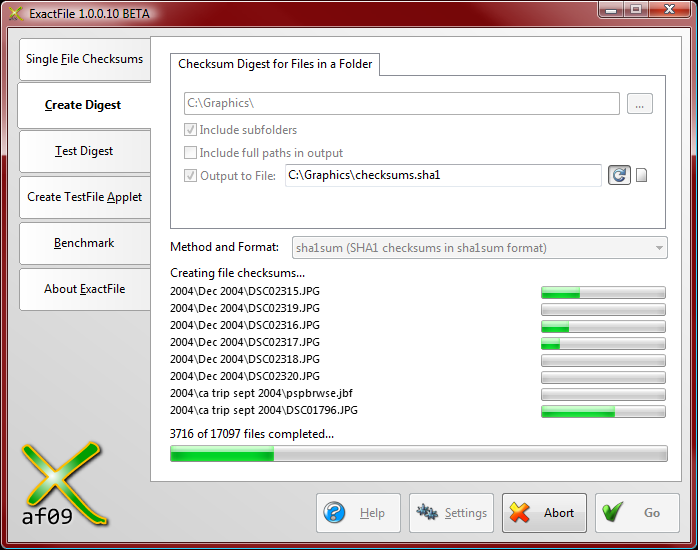
The Create Digest function generates a “checksum digest” (a list of file “signatures”) for all of the files in a particular folder on your computer.
ExactFile supports several checksum formats, including MD5, SHA1, SFV (CRC32), and others.
Enter the path to the folder for which you wish to have the digest created, or click the browse button (…) to find it with a select folder dialog. You may also drag-and-drop a folder from Windows Explorer.
Select Include subfolders to recursively scan all folders in the path.
Select Include full paths in output if you want the digest to use explicit and full paths for each file. This is helpful if you are only using digest files for verifying file collections on your own computer for which the file locations will never change. This way you can store the digest file anywhere with no regard for the base folder. This is not useful if you intend to copy the files and verify them in another location. If you will be including the digest file when distributing files for others, do not use full paths, because if you do, the digest file will most likely be useless for others.
Select Output to File if you want the digest to be written to a file. You will usually want to do this, but you may want to suppress the file output in some situations. It is recommended that rather than manually specifying the digest file name, you allow ExactFile to automatically generate it and place the file. You do this by leaving the Automatically Name Digest File button toggled on (the “round arrow” button), so that the digest file will always be placed in the base folder you are scanning and given an appropriate name/extension. However, you can click the Browse for Digest Output File button (or manually type the output file path name) if you wish to have it stored elsewhere. Note that ExactFile will always overwrite this file if it already exists, without prompt.
Select the Method and Format for the digest file. The three most popular digest formats are MD5 (md5sum format), SFV, and SHA1 (sha1sum format). Additionally, ExactFile can create digest files compatible with FileCheckMD5. Finally, if you wish to use a less common checksum routine, like GOST or RIPEMD (etc), ExactFile can create an “extended md5sum” format digest file.
If you need help deciding which to use: Pick the first option, MD5. This will create a standard md5sum digest file that can be read by most file checksum utilities. A more robust and “reliable” checksum is SHA1, with SHA512 being the strongest. However, for simple file verification uses, MD5 is an excellent choice because it is fast and “good enough” to test if a file has been damaged on disc or during download.
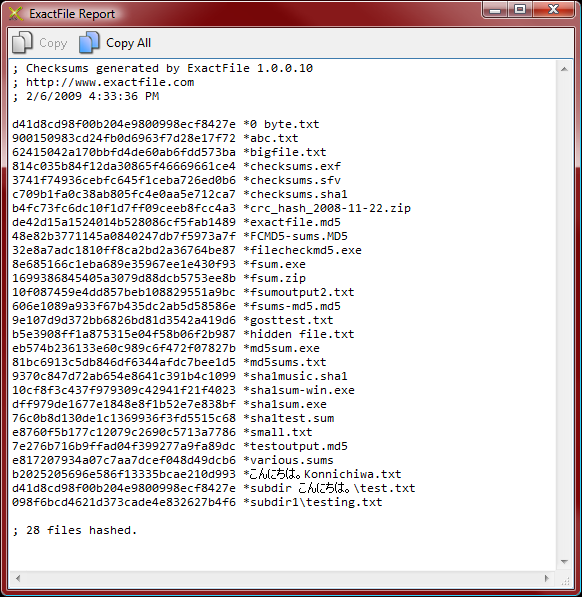
Click Go to begin the process. The digest will be shown in a report window and also saved to the file specified (if you have opted to select the Output to File option).
Although the program works very well I would like a feature that allows me to save a ‘checksum digest’ within each subfolder automatically.
I have about half a million files in many levels of subfolders and when I run the program it tries to generate a list for all the files on the entire drive in the root folder – if it automatically saved it in each relavant subfolder my problem would be solved.
As a side note it would be good for some people who like to save a checksum .md5 for each file name when doing an indepth scan.
Keep up the good work!
(One of) The best hashing tool(s) I’ve found in my extensive research and the first that flawlessly meets all requirements for my needs, such as full unicode support, variety of supported hash algorithms and processing of recursive directory structures.
While jDigest does a great job as well, it did falsely return mismatches for a few files in rare cases.
Two things that I really liked to have though (this is meant to be constructive feedback of course) are
A) a ‘data throughput gauge’ when hashing single files/directories and
B) the option to choose multiple folders/files to be hashed in one run (rather than only one folder or the whole drive, which forces you to hash all containing files and folders on the root level of that drive).
Just my 20 cents~ and with or without those ExactFile is a fantastic tool and handles files with utf-8 encoded names very well (which still seems to be a problem with many hashing tools – including hashdeep/md5deep).
Thanks for offering that fantastic tool for free!
Great program but it would be nice to have it in a context menu so when I’m in Windows Explorer I can just RIGHT CLICK with the mouse on a FOLDER and have the program pop up and ready to make a checksum file.
QuickSFV does this but it only makes SFV files and I prefer to make MD5 files.
I really like this tool! However, when I tried to hash a folder with 5100 files, it only hashed 5020 files… My windows explorer counts 5100 files, the Exactfile report counts only 5020… Why? I selected to hash all files and all subfolders.
Could be hidden files.
I’m trying this file to file integrity verification and seems to work fine. I really like and think it’s a wonderful tool. I need to implement a file integrity verification in a organization.
Nice software, Brandon. I ran into the same issue as @Freak. I was actually using ExactFile to get to the bottom of a file number discrepancy from another program. I’d used a file syncing program to copy files between partitions, and then checked the properties of the source and target directories in Windows Explorer to make sure the number of files, folders, and size matched exactly. They were off by 1 file out of over 19,000. ExactFile did reveal the source of that discrepancy for me, but its own count of files hashed was way off from the source.
If that’s due to hidden files, could there be an option to include / exclude them?
Also, re: the setting “Use only one thread on written CD media”, is it possible to detect when an image of an optical disc is mounted as a virtual drive? The multi-threading is desirable in that case.
I also would like to have the option to generate the digest in each subfolder rather than the base folder. Whereas the digest in the base folder would only contain the checksums for those files in that folder only.
This is a similar request like the post of “Jeremy May 2, 2010 at 9:12 am”. It would be wonderful.
If it is already doable in the present version, please advise how to find it.
Please keep up the good work. Wonderful tool.
I’d like to request for a feature to add new files to a digest. My folder has 50000+ files and rescanning the whole folder whenever a file is added is not feasible.